

How to Learn English Words from TV Shows and Movies
Watching more English does not teach you new words. Catching them does. Put English subtitles on, pause on the word that stopped you, and read its meaning. Then save it, or the next scene takes it away.
This article is published by Miji’s maker.
Why the word is gone by the next scene
A show never waits. The line lands, the scene moves, and your attention follows the story.
You guessed the meaning from the faces and the music. That guess feels like understanding. By tomorrow, nothing of it is left.
There is a second trap. You only heard the word, so you do not know how it is written. A word you cannot spell is a word you cannot find again.
So the skill is catching, not watching. Two seconds at the right moment beat another hour of screen time.
Set the show up so words can be caught
A few choices decide whether any word survives the episode.
- Put English subtitles on. Speech runs words together. The written line shows you where one word ends.
- Pick a show you would watch anyway. Enjoyment is what brings you back tomorrow, and coming back is the whole game.
- Match the level, roughly. If every third word is new, you are solving a puzzle, not watching a story.
- Stop at the word, not at the end. After the credits you still have the feeling and no longer have the word.
- Say the line out loud once. Your ear and your mouth each get a copy.
The ten seconds after you pause
The word is on screen. Make it yours before you press play again.
- Read the meaning that fits this scene. A common word carries several, and only one is in the room with you.
- Hear it said once, then say it yourself.
- Keep the line from the show as your example. It beats any sentence written for a textbook.
- Put the word somewhere that will ask you about it later.
That last step is where almost everyone stops. Growing gaps between questions are what turn a word into a memory, and the method is called spaced repetition.
Reading the whole entry helps too, not only the first line of it. Here is how to use a dictionary to learn English words.
How many words is one episode worth?
Two or three. Really.
One episode can throw dozens of unknown words at you. Save them all, and you will quit by the weekend.
Choose the ones with a future:
- A word you have now met twice, in two different places.
- A word you wanted last week and could not say.
- A word sitting in the middle of the plot or the joke.
Let the rest go by. A word from one court drama can wait for the next court drama.
More on cutting the list down: how to learn English vocabulary fast.
Podcasts work the same way, minus the picture
Audio is harder. There is no face to read, and no spelling on the screen.
Many shows publish a written copy of what is said. Where one exists, find the line and take the spelling from there.
No written copy? Type what you think you heard. English spelling is unfair, so try two or three guesses before you give up.
Where you listen helps you here. You are walking or riding a bus, so a ten-second stop costs you nothing.
Apps that help with the words you hear
Each one below does a different part of the job.
- Memrise is a language learning app for people with a specific reason to learn. Its lessons are built on videos of real native speakers.
- Merriam-Webster is an English dictionary app. Its voice search finds a word without you spelling it.
- Miji is an English dictionary for iPhone. Tap Remember on a meaning, and that word returns as a notification.
- Quizlet turns your notes and study sets into flashcards, and into conversational audio you can review on a commute.
- LookUp is a dictionary app with collections. You save words into them and practice with spaced repetition quizzes.
- Anki's iPhone app is a companion to Anki on a computer. A flashcard's audio clips sit on the device, so studying works without a connection.
The table holds each one's price, rating and last update. Miji's words and its row come from its App Store page, like the others.
| App | Price to download | Rating | Last update | Needs |
|---|---|---|---|---|
| Memrise: Language Learning App | Free | 4.8 from 210,000+ ratings | September 7, 2026 | iOS 15.0 or later |
| Miji: Dictionary & Flashcards | Free | No ratings yet | October 14, 2026 | iOS 26.0 or later |
| Merriam-Webster Dictionary | Free | 4.8 from 320,000+ ratings | September 22, 2026 | iOS 15.0 or later |
| Quizlet: More than Flashcards | Free | 4.8 from 1,100,000+ ratings | October 13, 2026 | iOS 17 or later |
| LookUp: English Dictionary App | Free | 4.7 from 3,100+ ratings | October 8, 2026 | iOS 26.0 or later |
| AnkiMobile Flashcards | $24.99 | 4.0 from 2,300+ ratings | September 8, 2025 | iOS 15.2 or later |
Miji: from a pause to a flashcard
You stopped a show for one word. That is the word Miji is built around.
Miji is a dictionary for iPhone. Type the first letters you are sure of, and the word comes up in the list.

Many meanings carry an example sentence of their own. A speaker button at the top says the word out loud. Choose the meaning the scene used.

That saved word comes back in two directions. The first hands you the word and asks what it means. The second runs the other way: meaning first, and you supply the word. There is nothing to type on either side.
Then the episode ends and Miji keeps working. Your word returns as a notification, and you answer Knew or Forgot from the lock screen.
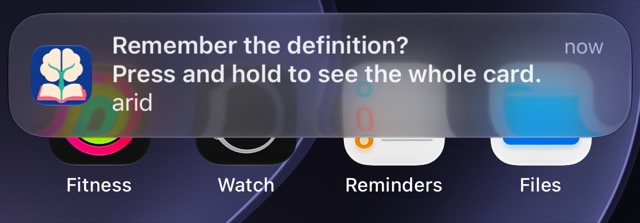
Notifications depend on your iPhone's permissions and settings.
Miji times those returns with FSRS, an algorithm Anki uses too. Missed a word? It comes back soon, and the answer still earns XP.
The dictionary and the practice both run on the phone. Neither one needs a signal, and no account is needed to learn.
Miji covers English only, and it needs an iPhone on iOS 26 or later. There are no shared decks and no sync. Heard the word but cannot spell it? Use Merriam-Webster instead for that first step: its voice search finds a word without you typing it. Want a whole language course? Memrise builds its courses around a goal, like an exam or speaking at work.
Miji is free to download. The free version starts with room for 10 words. Dictionary search, sound and practice cost nothing. Pro adds unlimited words and decks, and saving from any app.
Questions
How do you learn English vocabulary from movies?
Pause when a word stops you, and read its meaning with the subtitles on. Save that word, then answer it again over the next days. Two or three per film is plenty.
Should I watch with English subtitles or subtitles in my language?
English, if words are the goal. Your own language turns the show into reading, and the English slides past unheard.
How do you remember words from podcasts?
Same loop, without a screen. Stop the audio, get the spelling from a written copy or a guess, and save the word so it asks you again later.
How do you learn English with Netflix?
The service matters less than the habit. Subtitles on, pause at the word, read the meaning, save it, press play.
Does watching a lot of English TV build vocabulary on its own?
It builds your listening, and it teaches some words slowly. A word you never answer from memory stays a guess. The saving and the answering are what make it yours.