
How to Learn English Vocabulary Fast
Speed comes from the waste you cut, not the hours you add. Choose words you already meet, answer each one from memory, and let the gap grow before the next answer. A word you answer on four separate days beats a word you stared at once.
This article is published by Miji’s maker.
Why an hour with a word list is slow
You read fifty new words, and by the end they all look familiar. Familiar is not the same as known.
Recognition is cheap. Your eyes slide along the page while your memory sits still.
Then you need one of those words in a sentence, and nothing arrives. The words went in. They were never pulled back out.
Fast learning runs the other way. You make your memory do the work, at the moment it is about to fail.
Choose fewer words, and choose them well
Ten words you keep are worth more than a hundred you skim. So the first speed-up is a shorter list.
Three kinds of words earn a place on it:
- Words you met today. You have the sentence, the voice, the moment. Each of those is a handle your memory can grab.
- Words that keep showing up. A word that appears twice in one week will appear again next month.
- Words your goal needs. An exam, a job interview or a move abroad narrows the list for you.
Leave the odd ones out. A word you will meet once a decade can wait a decade.
Turn each word into a question
A word you know by sight is half learned. You want it in both directions.
One direction shows the word and asks what it means. That one serves your reading and listening. The other gives the meaning and asks for the word. That one shows up when you speak.
Keep one meaning per question, and keep the sentence you met it in. The full method sits in how to use spaced repetition for vocabulary.
Answer at the last useful moment
Timing decides how much each answer buys you.
Answer a word a minute after reading it, and you gain almost nothing. Wait until the word is nearly gone, and the same answer pushes it much deeper.
That is spaced repetition in one line. A right answer earns a longer wait. A miss brings the word back soon.
Nobody can feel that moment by hand across dozens of words. Software tracks it for each one. The measurements behind the idea are on the forgetting curve page.
Steal the small minutes
New words fit in the cracks of a normal day. You do not need a free evening.
- A line at the store, an elevator, a bus stop: one answer fits in each.
- Say the word out loud once. Sound gives your memory a second way in.
- Use a new word in a message you were sending anyway.
- Stop before you get bored. Tomorrow costs less than a long push tonight.
Where do the words themselves come from? Mostly from reading and listening, and from the dictionary you open when one stops you. Here is how to use a dictionary to learn English words.
Apps that make it quicker
Every app below can grow your vocabulary. They differ in what they teach and where the words come from.
- Duolingo teaches whole languages, English among them, in short lessons that fit a break.
- WordUp works through the most common English words and puts them in an order chosen for you. Its challenges use spaced repetition, so the timing is handled.
- Miji is an English dictionary for iPhone; tap Remember on a meaning, and it comes back as a notification.
- Memrise is a language learning app built on videos of native speakers, for people with a reason to learn.
- Anki on iPhone is a companion to Anki on a computer, and its scheduling reaches you as you are about to forget.
- Vocabulary.com teaches words through a game of questions, and it picks the best question for you at the right time.
Pick by the words you want. Choose Duolingo or Memrise instead if you want whole lessons in a language you are starting from scratch; their courses pick the words for you. Miji is for the English words you meet and look up.
The table below holds each app's price, rating, last update and the iPhone it needs.
| App | Price to download | Rating | Last update | Needs |
|---|---|---|---|---|
| Duolingo: Learn Languages | Free | 4.7 from 5,500,000+ ratings | October 12, 2026 | iOS 17.0 or later |
| Miji: Dictionary & Flashcards | Free | No ratings yet | October 14, 2026 | iOS 26.0 or later |
| WordUp - Vocabulary Builder | Free | 4.8 from 13,000+ ratings | September 28, 2026 | iOS 15.6 or later |
| Memrise: Language Learning App | Free | 4.8 from 210,000+ ratings | September 7, 2026 | iOS 15.0 or later |
| AnkiMobile Flashcards | $24.99 | 4.0 from 2,300+ ratings | September 8, 2025 | iOS 15.2 or later |
| Vocabulary.com | Free | 4.3 from 4,900+ ratings | September 22, 2021 | iOS 9.0 or later |
Miji: the shortest path from a word to a memory
Met a word this morning and lost it before lunch? That is the exact gap Miji closes.
Miji is a dictionary first. Search a word, and you get its meanings, its sound and example sentences.

Tap Remember under the meaning you picked.
Miji writes both questions for you. The first hands you the word and waits for a meaning. The second hands you the meaning and waits for the word. You type neither.

After that, practice comes to you. Each word arrives as a notification at the moment Miji picks, and you answer Knew or Forgot on the lock screen. Notifications depend on your iPhone's permissions and settings.
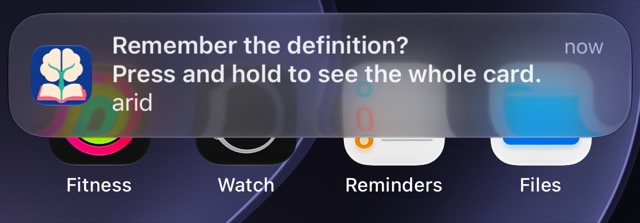
Miji uses FSRS to choose those moments, reading your answers as it goes. Miss a word? It comes back sooner, and you keep the XP for answering.
The dictionary is on the device and works offline: 85,000 English words with pronunciations, examples and related words. Learning needs no account.
Miji covers English only, on an iPhone running iOS 26 or later. It has no shared decks and keeps nothing in sync.
Miji is free to download. The free version starts with room for 10 words. Dictionary search, practice and notifications stay free.
Questions
How do you learn English vocabulary fast?
Keep the list short and answer each word from memory. Every right answer pushes that word further into the future, so your time goes to the shaky ones.
How can I improve my English vocabulary in a month?
Save every word that stops you, and answer the ones that fall due. A month of that leaves you with dozens of words you can use, not a list you once read.
What is the best way to learn English words quickly?
Take them from your own reading and listening. Those words arrive with a sentence around them, and that context does half the work for you.
Can you build vocabulary in English without flashcards?
Yes, by reading widely and meeting the same words often. It is slower per hour, and you cannot pick which words come back.
Is it better to learn words in a list or in sentences?
Sentences win. A list gives you a meaning; a sentence gives you the meaning plus where the word is allowed to stand.