
How to Use a Dictionary to Learn English Words
Use a dictionary in two moves. First, read the whole entry, not only the first line of it. Second, save that word and answer it again over the next days. Most people stop after the first move, and that is why the word disappears.
This article is published by Miji’s maker.
What an entry is really telling you
An entry is not one fact. It is five or six small ones. Each one gives your memory another handle to hold.
Here is what to read, and why:
- The sound. Tap the speaker button and say the word out loud. A word you can say is a word you can find again.
- The kind of word. Is it a noun, a verb or an adjective? That tells you where it can sit in a sentence.
- The meanings. A common word has several. Pick the one that fits the sentence where you met it.
- The example. An example sentence shows the word doing its job. Look at what stands before and after it.
- The related words. A synonym gives you a second way to say the thing. It also makes the meaning sharper.
Take the word "arid". One meaning is very dry, with little rain. Another is dull, with no feeling in it. Stop at the first meaning, and "an arid speech" will confuse you.

Read the meaning in English when you can
A translation is the fastest answer. It is also the thinnest one. An English meaning makes you think in English, and it walks you past words you already half know.
So use your own language when you are stuck. Then read the English meaning too, and let the example settle it.
The loop that turns a lookup into a word you own
Reading a meaning is not learning it. Learning happens when you pull the word back out of your own head later.
Here is the loop. It costs about a minute:
- Read the meaning that fits where you met the word.
- Say it out loud, twice.
- Write one sentence of your own with it, about your day.
- Save it. A word you cannot find again is a word you lost.
- Answer it again tomorrow, then in a few days, then next week.
Those growing gaps have a name: spaced repetition. You get asked just before the word would fade. See how spaced repetition works if the idea is new to you.
The looking up is easy. The coming back is the hard part, and it is the part an app can carry for you.
Which dictionary app should you use?
Each app below explains a word well. They differ in what happens after that.
- Oxford Advanced Learner's Dictionary is a reference app for learners of English. Its wording is kept clear and simple, and you can build your own favourites lists.
- Merriam-Webster is an English reference app with a word of the day and fast word games. It keeps your favourite words and your search history.
- Miji is an English dictionary that runs on your iPhone. Tap Remember on a meaning, and that meaning turns into flashcards that come back to you.
- Dictionary.com is a dictionary and synonym app. It adds a word of the day, idioms and rhymes.
- LookUp is a dictionary app with an illustrated word of the day. You save words into collections, then practice them with spaced repetition.
Choose Oxford Advanced Learner's Dictionary or Merriam-Webster instead if you want a reference to read and nothing more. Miji is the one that asks you about the word again later.
| App | Price to download | Rating | Last update | Needs |
|---|---|---|---|---|
| Oxford Advanced Learner's Dict | Free | 2.3 from 99 ratings | March 4, 2024 | iOS 13.0 or later |
| Merriam-Webster Dictionary | Free | 4.8 from 320,000+ ratings | September 22, 2026 | iOS 15.0 or later |
| Dictionary.com: English Words | Free | 4.8 from 320,000+ ratings | September 28, 2026 | iOS 16.0 or later |
| Miji: Dictionary & Flashcards | Free | No ratings yet | October 14, 2026 | iOS 26.0 or later |
| LookUp: English Dictionary App | Free | 4.7 from 3,100+ ratings | October 8, 2026 | iOS 26.0 or later |
Notice the split. Oxford Advanced Learner's Dictionary, Merriam-Webster and Dictionary.com hold on to the words you looked up, in lists or a search history. Miji and LookUp ask you about them again later. That second step is where the learning happens.
Miji: the word you look up becomes the flashcard
You read the whole entry this morning. By lunch the word is gone again. That is what Miji is for.
Miji is a dictionary first. Type a few letters, read the meanings, hear the word said.

Then pick the meaning you met.
Miji writes two flashcards from that one meaning. One asks you what the word means. The other gives you the meaning and asks for the word. There is nothing to type, on either side.

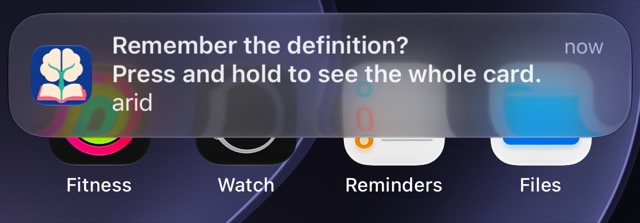
Practice does not wait for you to open anything. Each word comes back as a notification, and you tap Knew or Forgot on the lock screen. Notifications depend on your iPhone's permissions and settings.
Forgot one? Fine. It returns sooner, and the answer still earns you XP.
The dictionary is built in and runs offline, so a tunnel or a plane changes nothing. It holds 85,000 English words, with pronunciations, examples and related words. You need no account to learn.
Miji is English only, and it runs on iPhone with iOS 26 or later. It has no shared decks and no sync. You never write your own sentence in Miji; the meaning you tapped is the flashcard. Look a word up, tap Remember, and answer it when it comes back.
Miji is free to download. The free version starts with room for 10 words. Dictionary search, pronunciation and practice stay free.
Questions
How do you use a dictionary to learn English?
Read the whole entry, then use the word. Say it out loud and write one sentence with it. Save it, and answer it again tomorrow and later in the week.
How do you use an English dictionary effectively?
Stop rereading and start answering. Cover the meaning and try to say it from memory first. A second lookup feels like learning, but your memory did no work.
Is learning English with a dictionary enough on its own?
A dictionary is where you meet words. On its own it will not keep them. Meeting a word once leaves very little behind, so the review is what decides.
What dictionary skills do English learners need?
Pick the meaning that fits the sentence you met. Read the example before you close the entry. Check the sound. Then save the word for later.
Which dictionary app is best for English learners?
Oxford Advanced Learner's Dictionary is written for learners, in simple wording. Miji turns the word you looked up into flashcards and brings it back. LookUp also practices the words you save.