
What Is Spaced Repetition, and How Does It Work?
Spaced repetition is a way to learn by reviewing something just before you forget it. Each time you remember it, the next review waits a little longer. A few short reviews, spread over days and weeks, keep a word in your memory far better than one long study night.
This article is published by Miji’s maker.
Why you forget new words
Looked up a word yesterday, and it is gone today? Normal. Your brain drops new things fast unless you use them again.
In the 1880s, a German scientist named Hermann Ebbinghaus tested this on himself. He learned lists of made-up words. Then he checked how much he still knew after hours, days and weeks.
Much of what he learned was gone within a day. After that, the loss slowed down. This drop is now called the forgetting curve.
Each time you bring a memory back, it fades more slowly than before. So every review buys you a longer gap before the next one.
How spaced repetition works
Spaced repetition turns the forgetting curve into a plan. You review each word right before it would slip away. Here is the loop:
- You learn a new word.
- A short time later, you get a quiz on it.
- You remember it? The next quiz waits longer.
- You forget it? It comes back soon, and the gaps start small again.
Say you learn the word "arid" today. You might see it again tomorrow, then in a few days, then in a week or two. Each gap is longer, because your memory is stronger.
The method rests on two ideas that work together.
The first is spacing. Many short reviews over time beat one long session. Studying all night before a test can help the next morning. A week later, most of it is gone.
The second is recall. Reading a word again feels easy, and that is the problem. Trying to pull the meaning out of your own head is harder. That effort is what makes the word stick. This is why spaced repetition uses flashcards and quizzes, not rereading.
Forgetting is part of the method, not a failure. A missed word simply comes back sooner. Over time, each word needs your attention less and less often.
The Leitner box: spaced repetition on paper
You do not need an app to try it. In the 1970s, Sebastian Leitner described a simple system with paper flashcards and a few boxes.
- All new flashcards start in the first box, which you study every day.
- Get a flashcard right, and it moves to the next box.
- Later boxes get studied less often, such as every few days or once a week.
- Get a flashcard wrong, and it goes back to the first box.
Easy words drift to the back and rarely show up. Hard words stay in front until you know them.
The hard part is keeping track. You have to move every flashcard and remember which box is due. That is a lot of work by hand.
Spaced repetition apps
A spaced repetition app keeps the boxes for you. It tracks every flashcard and picks when each one comes back.
Anki can use FSRS, an open-source method for this, and Miji uses it too. FSRS uses your past answers to guess when you are about to forget.
These apps all use spaced repetition. Each one is built for something different:
- Anki is a flashcard program for computers and phones. Its iPhone app is a partner to the computer version.
- Noji is a flashcard study app for students, teachers and language learners.
- Mochi is an app for notes and flashcards. You can link your notes and flashcards to each other.
- Miji is an English dictionary for iPhone. The words you save come back as notifications until you know them.
- RemNote is an all-in-one learning tool for notes, flashcards and PDFs.
- Brainscape is a flashcard app where you rate how sure you felt after each flashcard.
Want a course in a new language instead? Memrise is a language learning app with courses and lessons. Studying a subject that is not English, or a deck you already keep on a computer? Go with Anki or Noji. Miji is built for the English words you look up. For those it asks the least of you: no deck, no typing, no session to sit down for.
| App | Price to download | Rating | Last update | Needs |
|---|---|---|---|---|
| AnkiMobile Flashcards | $24.99 | 4.0 from 2,300+ ratings | September 8, 2025 | iOS 15.2 or later |
| Miji: Dictionary & Flashcards | Free | No ratings yet | October 14, 2026 | iOS 26.0 or later |
| Noji - Flashcards study app | Free | 4.6 from 13,000+ ratings | September 24, 2026 | iOS 16.4 or later |
| Mochi - Flashcards and notes | Free | 4.6 from 170+ ratings | September 16, 2026 | iOS 15.6 or later |
| RemNote - Notes & Flashcards | Free | 4.8 from 1,600+ ratings | October 15, 2026 | iOS 16.5 or later |
| Brainscape - Study Flashcards | Free | 4.8 from 21,000+ ratings | October 5, 2026 | iOS 16.6 or later |
| Memrise: Language Learning App | Free | 4.8 from 210,000+ ratings | September 7, 2026 | iOS 15.0 or later |
Where do the flashcards come from?
- In Anki, you can add flashcards on a computer, then study them on your iPhone.
- In Noji, you create flashcards, or pick a ready-made deck from its library.
- In Miji, you tap Remember on a word you looked up, and Miji makes two flashcards.
- In Mochi and RemNote, you can make flashcards straight from your notes.
- In Brainscape, you make flashcards from notes and images, or study flashcards made by experts and other people.
Any of these ways works with spaced repetition. Pick the one that fits what you want to learn.
If you are coming from Anki, see the best Anki alternatives for iPhone.
Miji does the spacing for you
In Miji, spaced repetition starts in the dictionary. Look up a word, tap Remember, and answer the notification when it comes. There are no flashcards to write and no boxes to keep track of.
Miji is a dictionary first. It has 85,000 English words with pronunciations and example sentences. The dictionary is built in and works offline, and you do not need an account to learn.

Each tap on Remember makes two flashcards, so you practice recall in both directions. One shows the word and asks what it means. The other shows the meaning and asks for the word.
Then Miji keeps track of every word, like a Leitner box that runs itself. When a word is due, its flashcard arrives as a notification. Tap Knew or Forgot right on the lock screen. There is no study session to plan.
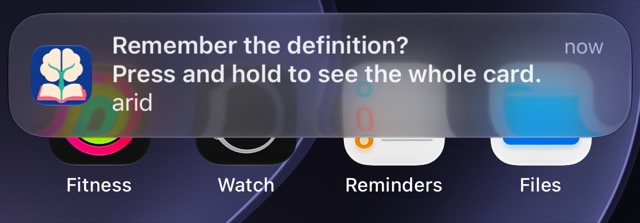
Forgot a word? Like a flashcard going back to the first box, it returns soon. You still earn XP for the answer.
Notifications depend on your iPhone's permissions and settings. Due words also wait in Miji, under the search field.

Here is what Miji does not do. It is English only. It runs on iPhone only, with iOS 26 or later. There are no shared decks and no sync.
The free version starts with room for 10 words. Dictionary search and practice stay free. Pro adds unlimited word capacity, unlimited decks and saving from any app.
Questions
What is spaced repetition?
It is a learning method where you review something just before you would forget it. Every right answer pushes the next review further away.
How does spaced repetition work?
Each time a word comes back, you try to pull its meaning from memory. Get it right, and the next quiz waits longer. Miss it, and it comes back soon.
Why is spaced repetition a good learning method?
It spends your time where it helps. You skip what you know well and practice what you are about to lose. A few short reviews can do the work of many long ones.
What is the easiest way to start spaced repetition?
Start with words you actually meet. In Miji, tap Remember on a word you looked up. Miji makes the flashcards and does the spacing for you.