

What Is the Forgetting Curve, and How Do You Beat It?
The forgetting curve is the shape of how fast you lose something you just learned. It falls steeply in the first day, then flattens out. You beat it by answering a quiz on the thing just before the fall takes it. Do that a few times and the curve gets flatter each round.
This article is published by Miji’s maker.
What the forgetting curve looks like
Picture a line on a graph. Time runs to the right. How much you still know runs up.
Learn something new, and the line starts at the top. Within a day, a lot of it is gone. After that the drop slows, and the line flattens.
That shape is the curve. The steep part is why a word you looked up at lunch is missing by dinner.
The curve is not a rule someone made up. It is a measurement, taken over and over, of what happens when you learn a thing and then leave it alone.
What Ebbinghaus actually measured
The curve is named after Hermann Ebbinghaus, a German researcher who tested it on himself in the 1880s.
He did not use real words. He learned long rows of made-up syllables, thirteen to a row. Syllables carry no meaning, so nothing he already knew could help him.
Then he waited, and learned the same row again. His measure was how much time that second round saved him. He called it savings.
Savings of 100% means nothing was lost. Savings of zero means he was starting from scratch. Every point on the curve is one of those scores.
It cost him seven months, often three sessions a day. One person, one memory, tested again and again.
What modern work says
In 2015, two researchers at the University of Amsterdam ran the experiment again. They published a replication of the Ebbinghaus forgetting curve in the journal PLOS ONE.
One person spent 70 hours on it. He learned rows of syllables, then learned them again after 20 minutes, an hour, nine hours, a day, two days and 31 days.
The result looked like the original. More than a century later, the shape held.
They found something odd, too. The line is not perfectly smooth. Savings jump up around the one-day mark. Sleep is the leading explanation, and the paper says that still needs proving for this kind of study.
So the curve is real, and it is not a sentence passed on every word you meet. How steep your own line falls depends on the word, how well you learned it, and when you meet it next.
How to beat the forgetting curve
You cannot switch the curve off. You can flatten it. Four habits do most of the work.
- Test yourself instead of rereading. Pulling an answer out of your head is hard. That effort is what makes it stay.
- Wait until it is nearly gone. A review right after learning is cheap and does little. A review at the edge of forgetting does far more.
- Spread the reviews out. Five short rounds over two weeks beat one long night of study.
- Let the gaps grow. Every time you get it right, push the next review further away.
Put those together and you have spaced repetition. The method exists because of this curve.
Apps that watch the curve for you
By hand, this means tracking when every word is due. Software is better at that job.
Each app below schedules with spaced repetition. Each one is built for something different:
- Quizlet turns your notes and recorded lectures into study sets. Its spaced repetition brings back what you need to review, right when you need it.
- Anki on iPhone is a companion to Anki on a computer. It uses the same scheduling, which reminds you of material as you are about to forget it.
- WordUp is built for learning English vocabulary. It ranks common English words for you and uses spaced repetition to keep them.
- Miji is an iPhone dictionary. Tap Remember on a word you looked up, and it returns as a notification until you know it.
- Brainscape asks you to rate how sure you felt after each flashcard, then sets your review timing with spaced repetition.
- Knowt turns your notes into flashcards, then uses spaced repetition so you remember them longer.
Choose Quizlet or Knowt instead if the material you are forgetting is a set of notes or a lecture; both build the flashcards from what you already wrote. For single English words, Miji starts from the lookup, so there is nothing to write at all.
| App | Price to download | Rating | Last update | Needs |
|---|---|---|---|---|
| Quizlet: More than Flashcards | Free | 4.8 from 1,100,000+ ratings | October 13, 2026 | iOS 17 or later |
| AnkiMobile Flashcards | $24.99 | 4.0 from 2,300+ ratings | September 8, 2025 | iOS 15.2 or later |
| WordUp - Vocabulary Builder | Free | 4.8 from 13,000+ ratings | September 28, 2026 | iOS 15.6 or later |
| Miji: Dictionary & Flashcards | Free | No ratings yet | October 14, 2026 | iOS 26.0 or later |
| Brainscape - Study Flashcards | Free | 4.8 from 21,000+ ratings | October 5, 2026 | iOS 16.6 or later |
| Knowt: AI Flashcards & Notes | Free | 4.7 from 11,000+ ratings | October 15, 2026 | iOS 16.4 or later |
Miji catches the word before the curve does
Here is the real problem with the curve. You look a word up, you move on, and nothing brings it back. The fall happens with nobody watching.
Miji closes that gap. Look up a word in its dictionary, tap Remember, and the word is on a schedule.
That tap writes two flashcards. One asks what the word means. The other gives the meaning and asks for the word.
Miji uses FSRS to choose the moment. It reads your answers and aims each review at the edge of your curve.

The review reaches you as a notification. Answer Knew or Forgot from the lock screen, and that word is handled. There is no session to plan and no app to open.
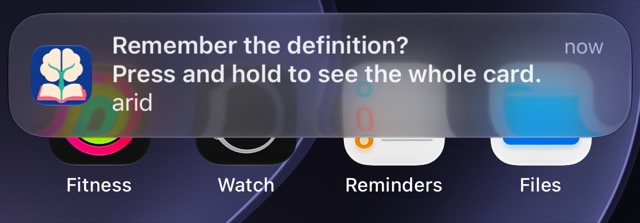
Notifications depend on your iPhone's permissions and settings.
Forgot a word? Good. It returns sooner, and you still earn XP for answering.
The dictionary sits on the device and works offline: 85,000 English words with pronunciations and example sentences. Learning needs no account.
A few things Miji will not do. It covers English only, on iPhone with iOS 26 or later. You won't find shared decks to download, and nothing syncs between devices.
Miji is free to download. The free version starts with room for 10 words. Dictionary search and practice stay free.
Questions
What is the forgetting curve?
It is the shape of how fast new learning fades. Most of the loss lands in the first day. What survives that day fades far more slowly.
What is the Ebbinghaus forgetting curve?
It is the original one, measured by Ebbinghaus on himself in the 1880s. He learned rows of made-up syllables and tracked how much time it saved him to learn them again.
How do you beat the forgetting curve?
Quiz yourself just before you would forget, and keep pushing the gaps wider. That is spaced repetition, and an app can time it for you.
How are the forgetting curve and spaced repetition connected?
Spaced repetition is the plan built on the curve. It aims each review at the point where your line is about to drop.
How many reviews does one word need?
Fewer than you would guess, if the timing is right. Each correct answer buys a longer gap, so reviews thin out fast.