
The Best Apps to Learn English Vocabulary (2026)
The best English vocabulary app depends on where your words come from. Duolingo, Babbel, Busuu and Memrise teach you a language course, lesson by lesson. WordUp works through the most common English words, Miji keeps the ones you meet by accident, and Oxford Advanced Learner's Dictionary explains them.
This article is published by Miji’s maker.
Two kinds of vocabulary app
Every app here grows your English. They start from opposite ends.
A course app picks the words for you. Lesson three has its words, lesson four has the next ones. That is a good way to begin, and grammar comes along with it.
The other kind starts from words you actually met. One came out of an email. One came out of a show you paused. Nobody planned those words, and nobody will bring them back unless you ask.
Most adults need both ends. A course builds your floor. Your own words build your ceiling, because those are the ones your week keeps asking for.
What to look for
Four questions sort these apps fast.
- Where do the words come from? A course chooses them. A dictionary lets your day choose them.
- Does it ask you again later? A word you met once and never again is gone by Friday.
- How much work is one new word? If saving a word costs a minute, you will stop saving words.
- How does practice reach you? An app you must remember to open is an app you will forget.
That third question is where most people quit. The fourth one is where the rest quit.
Reviews with growing gaps have a name: spaced repetition. New to the idea? Start with how spaced repetition works.
The best apps to learn English vocabulary in 2026
Every app below is free to download. What the free version gives you is the part that differs.
The course apps come first, then the apps built around one word at a time. Each entry says what its own store page claims.
Duolingo
Duolingo is built for learning a whole language in short, game-like lessons. You practice speaking, reading, listening and writing, and your vocabulary grows with your grammar. English is one of its courses, so you can learn English words this way.
Good if you are starting out and want a daily habit with no thinking about what to study.
Babbel
Babbel is built for real-life conversation. Its courses are tailored to your native language, so a French speaker and a Spanish speaker get different lessons. Babbel's page names a smart review system, and you can download lessons and learn offline.
Busuu
Busuu is built for talking with confidence early. Its lessons come with feedback and tips from a community of native speakers. Its Smart Review saves the grammar and vocabulary from your lessons and keeps them in one place.
Memrise
Memrise is built for people with a specific reason to learn. It sorts its courses by goal: an exam, work, family, a country you love. Lessons are built around videos of real native speakers, so you hear how people say a thing.
Miji
Miji is an English dictionary for iPhone, built for the words you look up. Tap Remember on a meaning, and Miji writes the flashcards itself. Each saved word then comes back as a notification until you know it.
A course picks your words for you. Miji learns the ones your own day hands you, which are the ones you will meet again.
WordUp
WordUp is built for English vocabulary and nothing else. It works through the most common English words and puts them in an order chosen for you. Its challenges ask you to pronounce, spell, define and use a word in context, and spaced repetition brings them back.
Oxford Advanced Learner's Dictionary
This one is a reference for learners of English. Its meanings are written in clear, simple language for people who are not native speakers. The content reads offline, words are spoken in British and American accents, and you can build your own lists.
Here is the price, the rating and the last update for each one.
| App | Price to download | Rating | Last update | Needs |
|---|---|---|---|---|
| Duolingo: Learn Languages | Free | 4.7 from 5,500,000+ ratings | October 12, 2026 | iOS 17.0 or later |
| Babbel - Language Learning | Free | 4.7 from 750,000+ ratings | October 8, 2026 | iOS 17.0 or later |
| Miji: Dictionary & Flashcards | Free | No ratings yet | October 14, 2026 | iOS 26.0 or later |
| Busuu: Language Learning App | Free | 4.7 from 100,000+ ratings | October 4, 2026 | iOS 18.0 or later |
| Memrise: Language Learning App | Free | 4.8 from 210,000+ ratings | September 7, 2026 | iOS 15.0 or later |
| WordUp - Vocabulary Builder | Free | 4.8 from 13,000+ ratings | September 28, 2026 | iOS 15.6 or later |
| Oxford Advanced Learner's Dict | Free | 2.3 from 99 ratings | March 4, 2024 | iOS 13.0 or later |
Which one fits you
Pick by your own situation, not by the biggest name.
- Starting English close to zero? Take a course. Duolingo, Babbel and Busuu each walk you through one.
- Learning for an exam or a job? Memrise sorts its courses by the reason you are learning.
- Reading English fine, but single words stop you? Miji catches each word at the moment you look it up.
- Want a ranked pile of words to work through? WordUp orders common English words for you.
- Need the meaning itself, in plain English? Oxford Advanced Learner's Dictionary is written for learners.
There is no rule against two. A course in the morning and your own words all day is a strong pair.
Miji: today's lookup, tomorrow's flashcard
A course hands you its words. Miji works the other way round. It starts with the word you just met and could not name.
Miji is a dictionary first. Type a few letters, read the meanings, hear the word said out loud.

Now tap Remember, on whichever meaning you needed.
That tap writes two flashcards for you. One gives you the word and asks for its meaning. The other runs the opposite way, meaning first. You type neither side.

Now the practice comes to you. A due word arrives as a notification, and you tap Knew or Forgot on the lock screen. No session to plan, no app to open.
Notifications depend on your iPhone's permissions and settings.
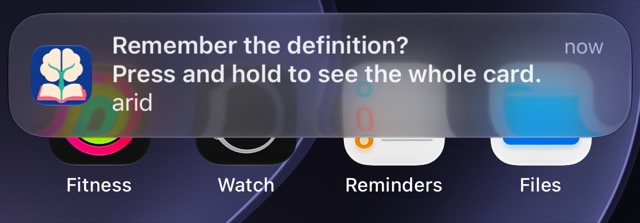
Miji chooses each day with FSRS, the same algorithm modern Anki uses. Forgot a word? It comes back sooner, and you still earn XP for saying so.
The dictionary sits on the phone and runs offline. Inside are 85,000 English words, with examples, pronunciations and related words. Learning needs no account.
Here is what Miji will not do for you. Miji covers English only, and runs on iPhone with iOS 26 or later. There are no shared decks, and there is no sync. For a full course in a language, take one of the course apps above.
Miji is free to download. The free version starts with room for 10 words. Search, pronunciation and practice stay free. Pro raises how many words you can keep.
Questions
What is the best app to learn English vocabulary?
It depends on where your words come from. For a course, try Duolingo, Babbel, Busuu or Memrise. For words you meet yourself, Miji saves them as you look them up, and WordUp gives you a ranked list instead.
Is there a free app to learn English vocabulary?
Yes. Every app in the table above is free to download, and each one sells a paid upgrade. Miji's free version keeps dictionary search and practice, with room for 10 words.
What is the best English vocabulary app for adults?
Adults meet most new words at work, in reading, and in shows. A course starts from its own word list. Miji starts from the word you just met, and keeps it.
Which app teaches English words the fastest?
The fastest app is the one whose practice actually happens. A lesson you skip teaches nothing. Miji answers this by putting the flashcard in a notification, so the review takes seconds.
Can I use two vocabulary apps at once?
Yes, and many people should. Run a course for structure, and keep a second app for the words your own day throws at you.