

What Is the Leitner System, and Does It Still Work?
The Leitner system sorts paper flashcards into a row of boxes. Answer one right, and it moves up a box. Miss it, and it goes back to the first box. The method still works, and an app can now do the sorting for you.
This article is published by Miji’s maker.
Where the boxes came from
Sebastian Leitner was a German science writer. In the 1970s he described a study box for paper flashcards, divided into smaller boxes.
The box was never the clever part. The rule for moving a flashcard between the boxes was.
How the Leitner box method works
Picture five boxes in a row. Every flashcard sits in exactly one box at a time.
The rules are short:
- New flashcards start in the first box.
- You study the first box every day.
- Answer a flashcard right, and it moves one box along.
- Miss a flashcard, and it returns to the front, wherever it was.
- Each box further along is studied less often.
A common plan runs like this. The first box comes back every day. The second box waits two days. The third box is twice a week. The fourth box is weekly, and the fifth is once a month.
Those gaps are not fixed. Pick a rhythm you can keep.
Give it two weeks and your flashcards spread out. The easy ones drift to the back and rarely come up. The ones you keep missing crowd the front, which is where your time should go.
What the Leitner system gets right
It is a small idea doing a lot of work.
- You answer from memory. A flashcard is a question, not a page to reread. The effort of digging out the answer is what makes it stay.
- The gaps grow. Each correct answer buys a longer wait before that flashcard shows up again.
- Hard words get your hours. A word you miss is back tomorrow. A word you own waits a month.
- It costs nothing. Paper, a pen and something to stand the flashcards in.
That growing gap is spaced repetition in its plainest form. It pushes back on the forgetting curve, the steep drop that takes a lot of a new word within a day.
Where it breaks down by hand
Now the catch. You are the scheduler, and the job never ends.
- You track it all. Which box is due today? Nobody tells you, and nothing chases you.
- The box only knows right or wrong. It cannot tell a word you barely remembered from one you knew well.
- One gap covers a whole box. Twenty flashcards in a box wait the same days, though your grip on each one differs.
- A missed week blurs the plan. Skip some days and the boxes stop meaning what they claim.
- You write every flashcard first. For vocabulary that is the real bill: the word, the meaning, an example, both directions.
- The box stays home. Paper does not follow you onto the bus.
None of that makes the method wrong. It turns the method into work a phone can do for you.
Leitner system vs spaced repetition
These two are not rivals. The Leitner system is spaced repetition, run on paper with a fixed set of gaps.
Spaced repetition is the wider idea: meet a thing again right before it would slip away. Leitner chose a few gaps and made them simple enough to run by hand.
A modern scheduler keeps that idea and throws away the fixed gaps. It hands every flashcard its own date, read from how you answered it.
FSRS is one of those schedulers. Anki's iPhone app offers the same FSRS scheduling as Anki on a computer. Miji uses FSRS for every saved word. Mochi runs a spaced repetition algorithm over the flashcards you write in markdown.
Apps that keep the boxes for you
Software is good at the two jobs you dislike: knowing what is due, and choosing the next date. Each app below is built for a different kind of study.
- Anki sells an iPhone app built as a companion to Anki on a computer, with the same scheduling as that version.
- Noji is built for studying flashcards, your own or ones from its big ready-made library. Students, teachers and language learners all use it.
- Mochi holds notes and flashcards written in markdown, then studies them with spaced repetition.
- Miji is an iPhone dictionary whose lookups turn into flashcards, answered from the lock screen.
- Brainscape asks you to rate how sure you felt after each flashcard, then sets the review timing from that.
- Knowt turns your notes into flashcards, with a spaced repetition mode for holding them longer.
Noji's own App Store page names the thing it replaced: a pile of paper index cards. Go with Noji or Anki instead if your boxes hold a subject Miji does not cover, like history dates or medical terms; Miji's boxes hold English words only.
| App | Price to download | Rating | Last update | Needs |
|---|---|---|---|---|
| AnkiMobile Flashcards | $24.99 | 4.0 from 2,300+ ratings | September 8, 2025 | iOS 15.2 or later |
| Noji - Flashcards study app | Free | 4.6 from 13,000+ ratings | September 24, 2026 | iOS 16.4 or later |
| Mochi - Flashcards and notes | Free | 4.6 from 170+ ratings | September 16, 2026 | iOS 15.6 or later |
| Brainscape - Study Flashcards | Free | 4.8 from 21,000+ ratings | October 5, 2026 | iOS 16.6 or later |
| Miji: Dictionary & Flashcards | Free | No ratings yet | October 14, 2026 | iOS 26.0 or later |
| Knowt: AI Flashcards & Notes | Free | 4.7 from 11,000+ ratings | October 15, 2026 | iOS 16.4 or later |
Miji has no boxes to move
Paper charges you twice. Once for writing each flashcard, once for sorting it forever. Miji drops both bills.
Miji is the dictionary, and the box is gone. Look up a word and read the meaning that fits.

Remember writes two flashcards. One gives you the word and asks what it means. The second runs the other way, from meaning to word.
After that, the sorting is gone. Miji reads your answers and picks the day each word comes back.
The word arrives as a notification. Tap Knew or Forgot from the lock screen and that one is handled.
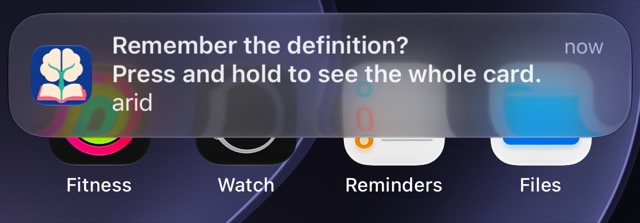
Notifications depend on your iPhone's permissions and settings. Anything due also waits inside the app, under the search field.

Missed a word? It comes round again within half an hour, and it pays the same XP as a right answer.
The dictionary lives on the device and works offline: 85,000 English words with pronunciations and example sentences. Learning needs no account.
What Miji will not do: other subjects, other languages, other phones. It is English on iPhone, with iOS 26 or later. Building decks and syncing them are not part of it.
Miji is free to download. The free version starts with room for 10 words. Pro adds unlimited word capacity, unlimited decks and saving from any app.
Questions
What is the Leitner system?
A way of studying paper flashcards, sorted into boxes by how well you know them. A right answer moves a flashcard up one box. A miss sends it to the front.
How do you use the Leitner box method?
Study the front box every day and the later ones on longer cycles. Promote a flashcard when you get it right, and send it back when you do not.
Is the Leitner system the same as spaced repetition?
It is one version of it. Spaced repetition is the general idea; Leitner is the paper recipe, with a fixed gap per box.
How many boxes do you need for Leitner flashcards?
Three to five is plenty. More boxes mean more sorting, and the extra gaps buy you very little.
Is the Leitner system still worth using?
Yes, if you like paper and will keep it up. If tracking it sounds like a chore, let an app pick the dates instead.